

A Hold Harmless Agreement is a legal document used to transfer liability from one party to another. It is often signed before an activity or transaction takes place where risk is involved. The party providing the indemnity, known as the Indemnitor, agrees to protect the other party, the Indemnitee, from legal claims, losses, or damages that may arise from the activity described in the agreement. This type of agreement is common in contractor relationships, equipment rentals, venue use, collaborative events, or service-based projects where at least one party wants to limit its exposure to third-party claims.
This Hold Harmless Agreement template is written for both general and business use. It includes fillable fields, checkboxes, and customizable clauses to define who is covered, what activities are included, and which types of legal claims are being addressed.
Hold Harmless Agreement Template
Clause-by-Clause Guide to the Hold Harmless Agreement
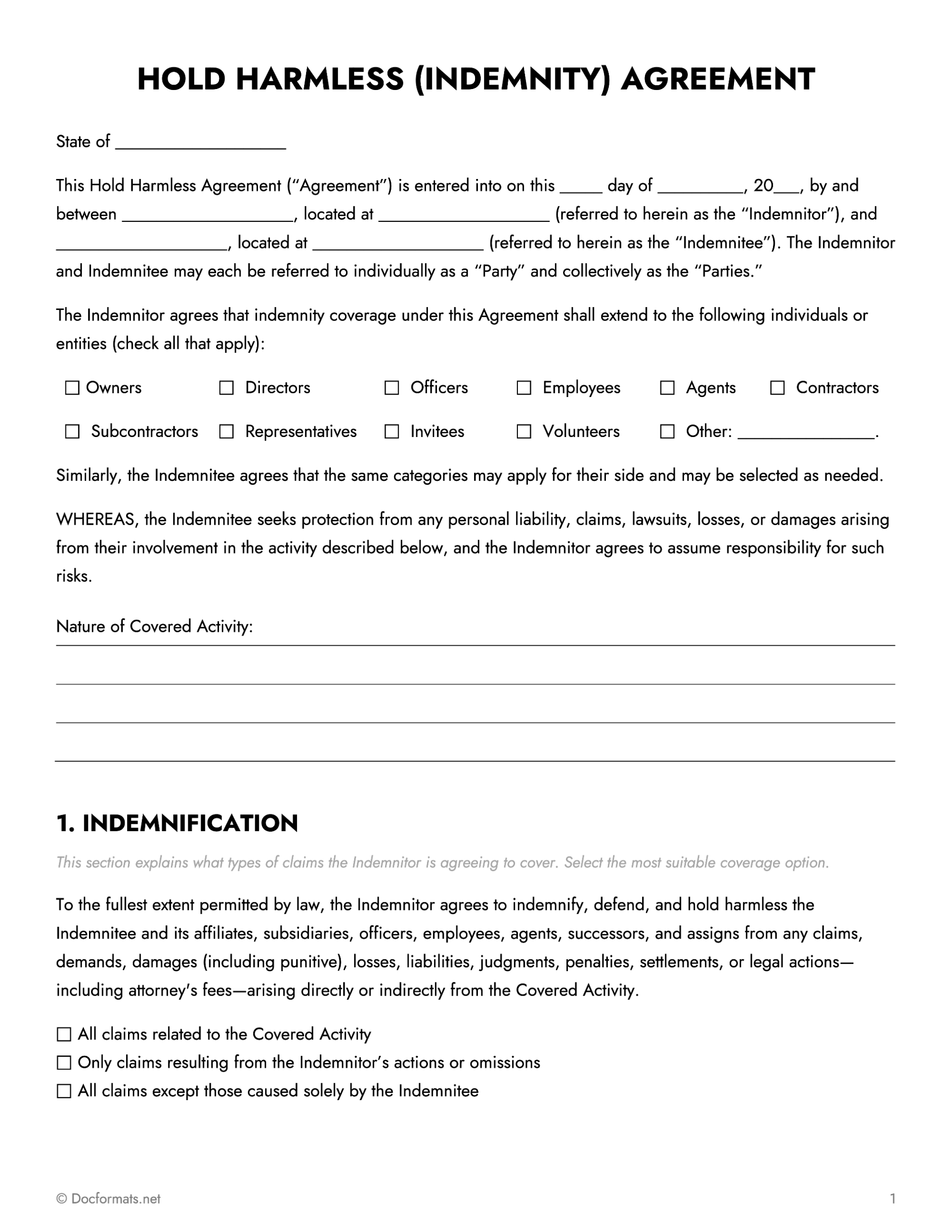
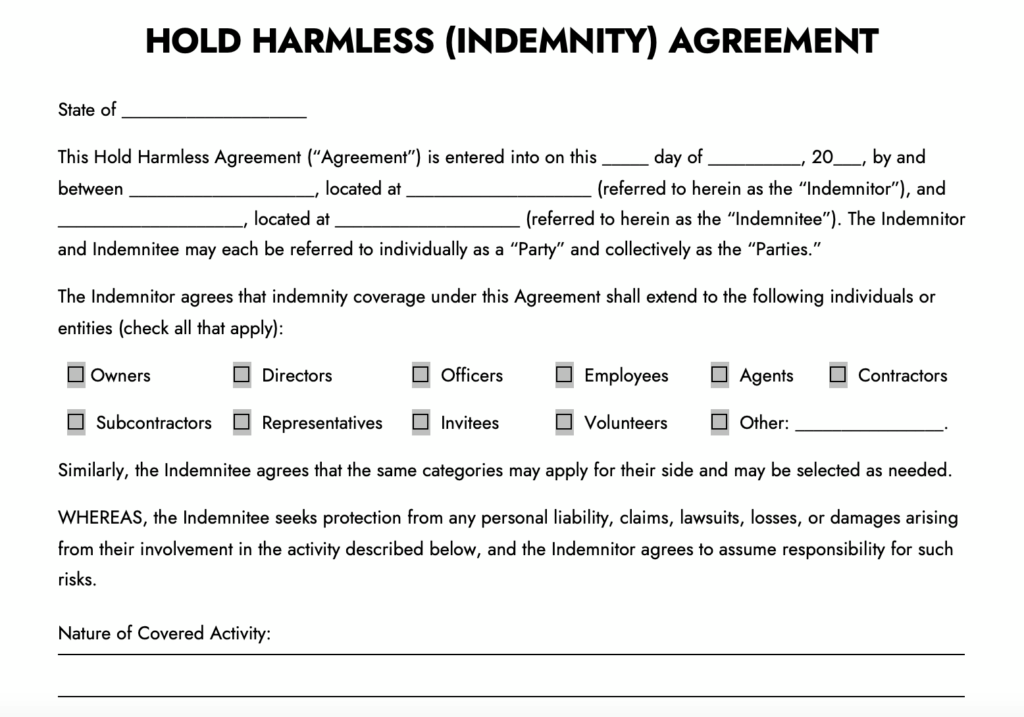
The agreement begins by identifying both parties: the Indemnitor, who agrees to accept legal and financial responsibility, and the Indemnitee, who is being protected under the terms of the agreement. After entering each party’s name and address, the next part includes checkboxes to define additional individuals or groups who will also receive protection—such as employees, subcontractors, or invitees. The activity covered by the agreement is then described in plain language. This activity can involve event coordination, property use, contracted services, shared work environments, or any arrangement where risk or liability may arise. These initial entries define the scope of the agreement and set the context for the clauses that follow.
Indemnification
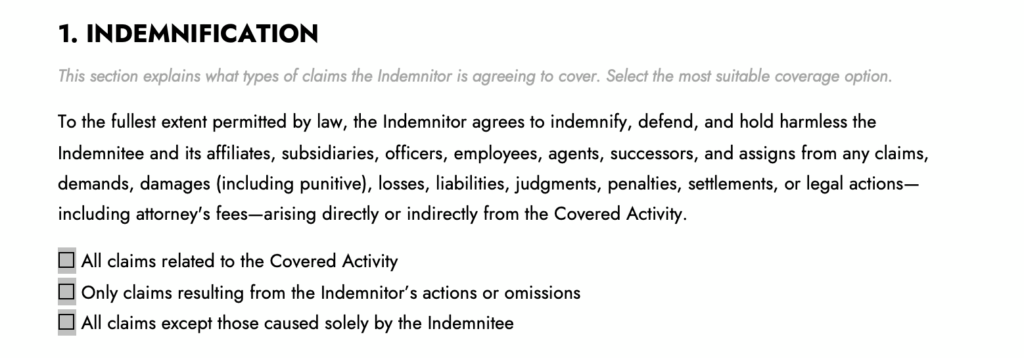
This clause defines the extent of legal responsibility being transferred from the Indemnitee to the Indemnitor. It establishes which types of claims the Indemnitor agrees to cover and under what conditions. The agreement presents three options to define the scope of indemnity: covering all claims related to the activity, covering only those caused by the Indemnitor, or covering all claims except those resulting solely from the Indemnitee’s conduct. The selected option determines how risk is distributed and specifies if liability includes shared faults or is limited to direct actions. This clause is central to the agreement and forms the basis of the protection provided.
Exceptions to Indemnity
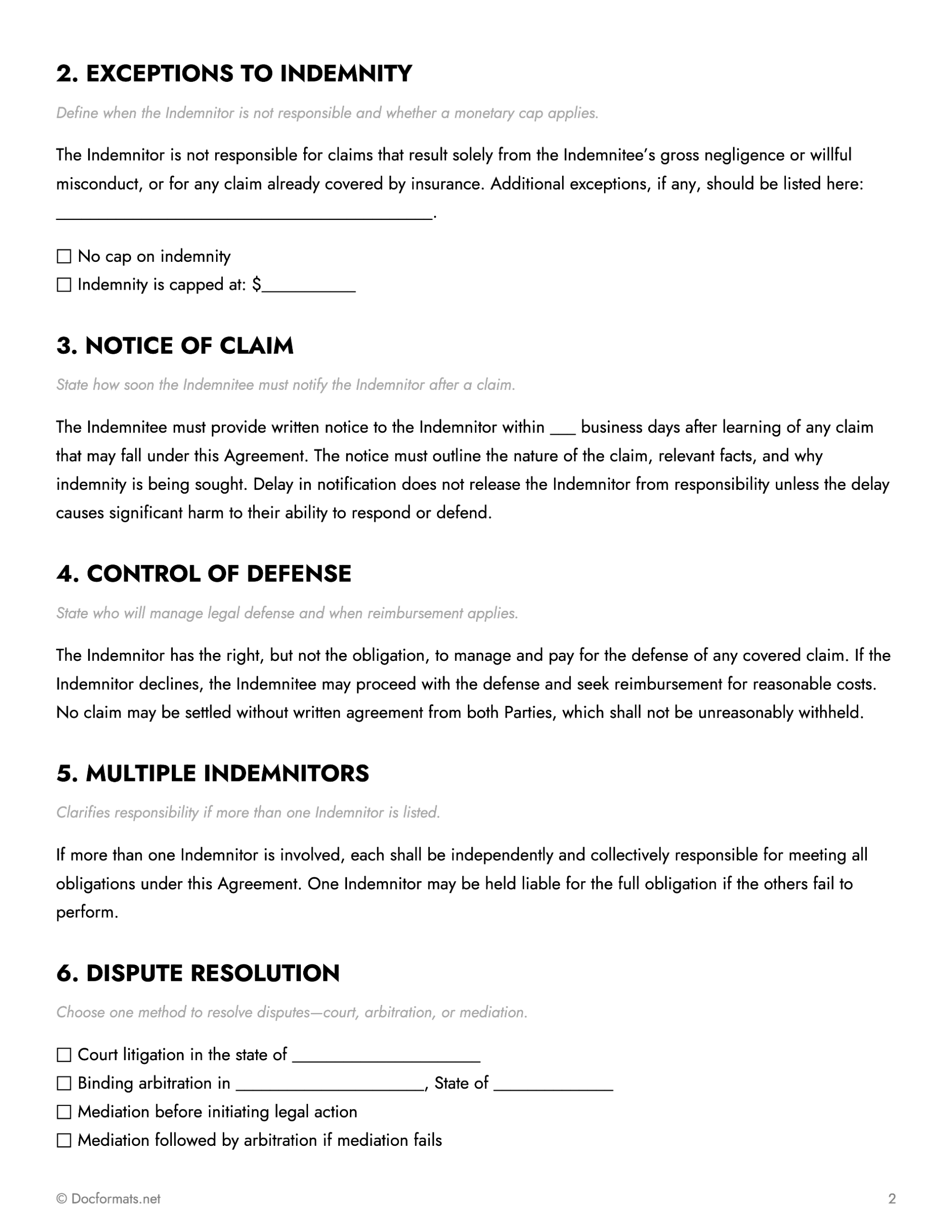
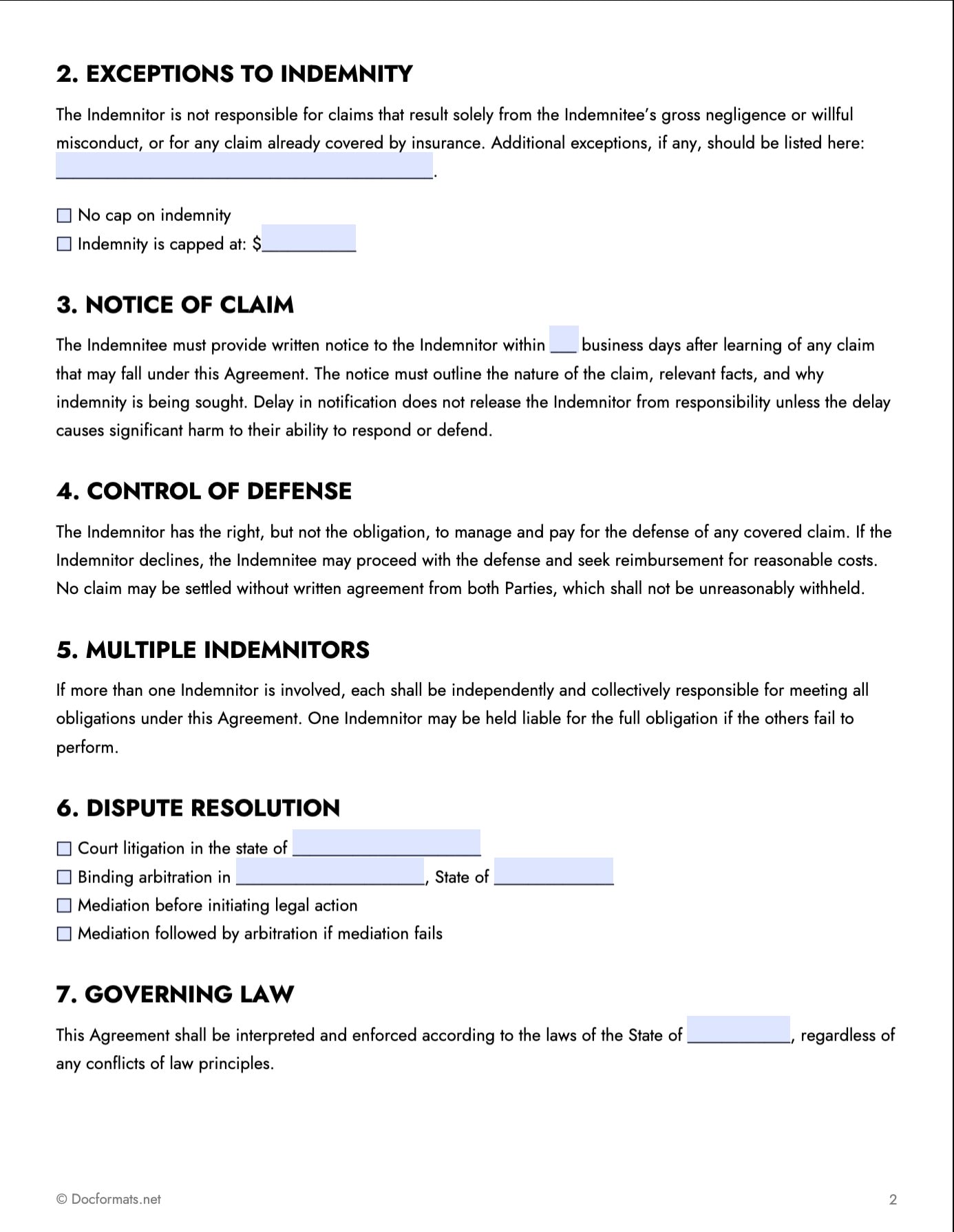
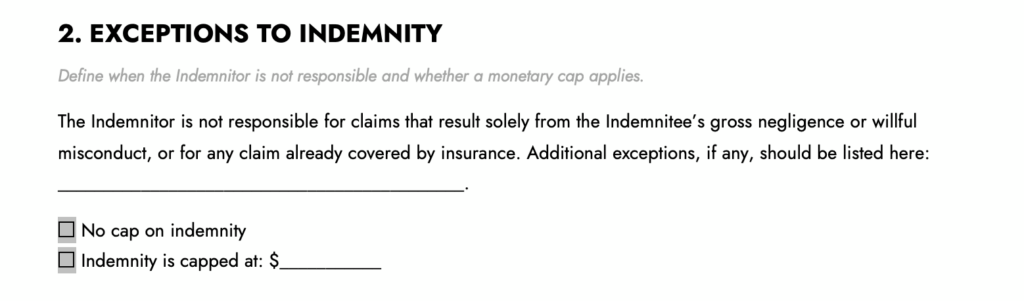
This section identifies the circumstances in which the indemnity does not apply. It excludes claims resulting from the Indemnitee’s gross negligence or intentional misconduct, and also removes coverage for any claims already addressed by insurance. Additional exceptions can be listed in the space provided, depending on the nature of the agreement or the risks involved. A separate field is included to set a monetary cap, if needed. Some agreements are left unlimited, while others impose a maximum indemnity amount based on the Indemnitor’s capacity or the potential risk exposure. This clause is used to set boundaries around the scope of responsibility being accepted.
Notice of Claim
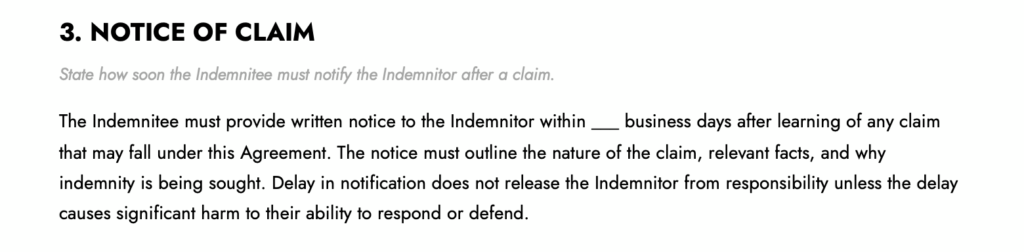
This clause sets a timeframe for when the Indemnitee must notify the Indemnitor after learning of a claim that may fall under the agreement. A blank field is provided to specify the number of business days within which notice must be given. The purpose of this requirement is to protect the Indemnitor’s ability to investigate the issue, prepare a defense, or respond through appropriate legal channels. A delay in notification does not automatically remove the obligation to indemnify, but enforcement may be limited if the delay causes material disadvantage to the Indemnitor. This clause ensures that communication occurs promptly and that both parties remain informed when a legal issue arises.
Control of Defense
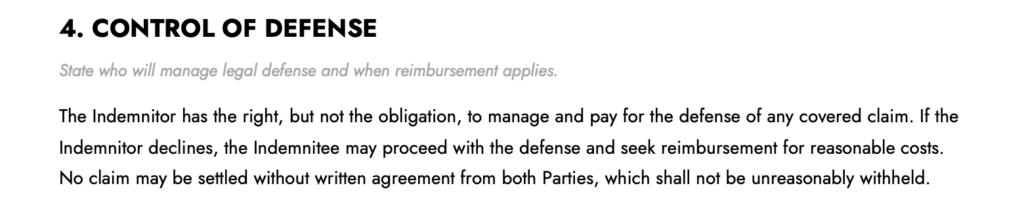
If a legal claim is made, this section determines who will handle the defense process. The Indemnitor has the first right to take control, choosing counsel, directing strategy, and managing communication. If the Indemnitor declines or fails to act, the Indemnitee may proceed and later request reimbursement for reasonable expenses. To prevent one-sided outcomes, this clause also requires both parties to agree in writing before any claim is settled.
Multiple Indemnitors
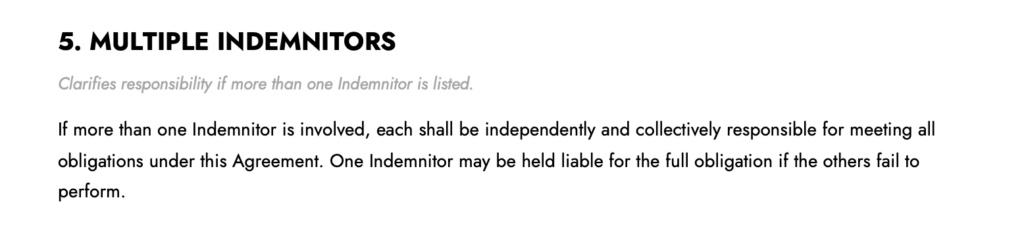
This clause addresses situations where more than one Indemnitor is named in the agreement. Each Indemnitor is treated as both individually and jointly responsible for fulfilling the indemnity obligations. This structure, known as joint and several liability, ensures that the Indemnitee can seek full recovery from any one Indemnitor if others fail to meet their obligations. It prevents enforcement delays and avoids complications that could arise if indemnitors attempt to divide responsibility among themselves. Any internal arrangements for cost-sharing between indemnitors do not affect the Indemnitee’s ability to enforce the agreement against any single party.
Dispute Resolution
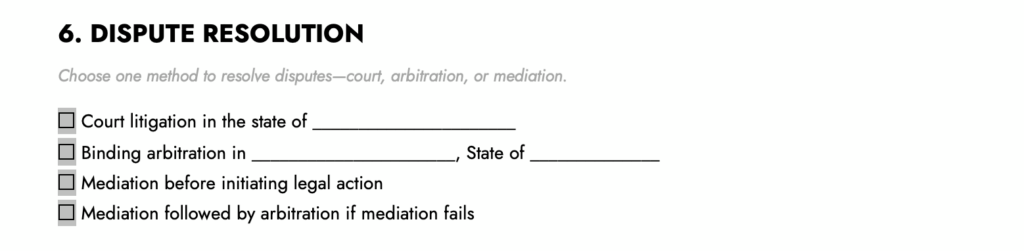
The agreement includes four options for resolving legal disagreements: litigation, binding arbitration, mediation, or a two-step process involving mediation followed by arbitration. Only one of these methods is selected before signing. Each option functions differently. Litigation involves a formal court process and permits appeals. Arbitration is typically faster and private, but the decision is final. Mediation emphasizes negotiation without binding authority unless followed by arbitration. Including this section ensures that both parties agree in advance on how disputes will be handled if they arise.
Governing Law
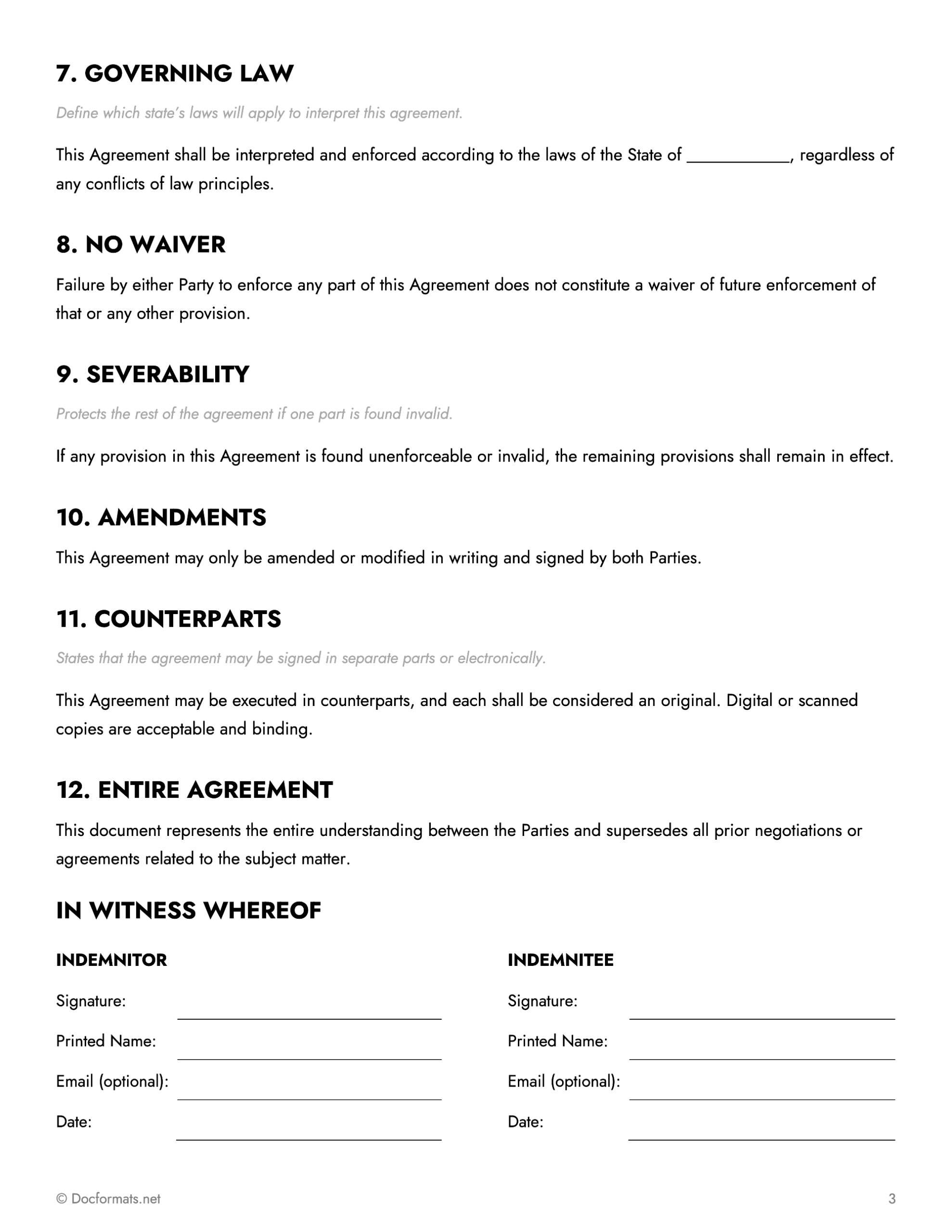
Legal interpretation of the agreement is based on the laws of the U.S. state named in this section. Selecting a governing law in advance prevents future disputes over jurisdiction and clarifies which state’s legal rules apply. The chosen state is typically where the activity takes place, where one of the parties is based, or where the agreement is signed. This clarification provides consistency in how the agreement will be interpreted and enforced.

No Waiver
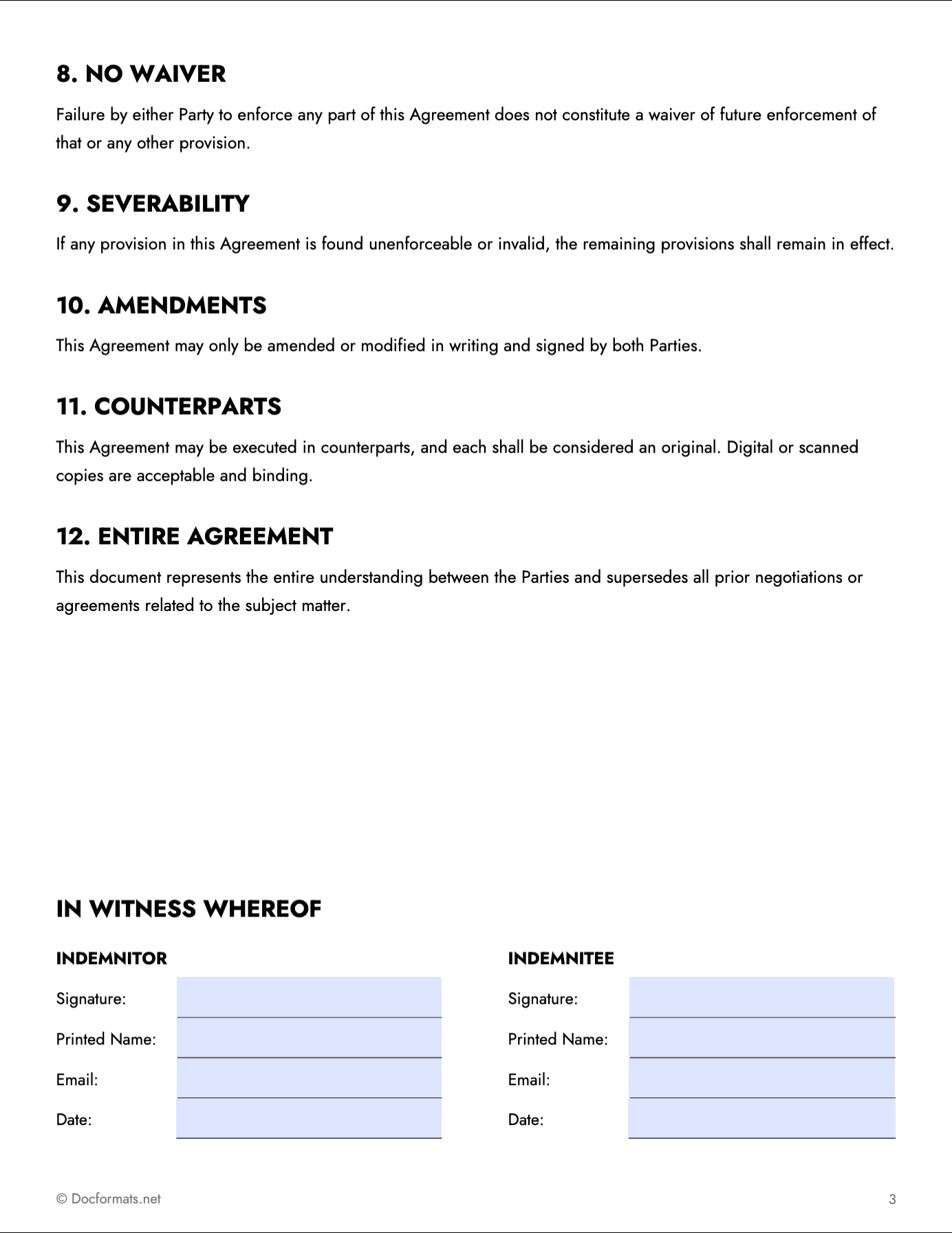
This section prevents either party from unintentionally giving up their rights under the agreement. If a party chooses not to enforce a specific term at one point, that decision does not prevent them from enforcing it later. This protection applies even if the non-enforcement happens more than once. The language helps maintain the full effect of the agreement by making it clear that one party’s inaction cannot be treated as permanent consent or dismissal of a term.

Severability
If any part of the agreement is found to be invalid, unenforceable, or in conflict with applicable law, the remaining sections continue to apply as written. This clause prevents the entire agreement from being voided due to one problematic provision. It preserves the original intent of the parties by keeping all unaffected terms in force, even if a court or legal authority modifies or removes one section.

Amendments
Changes to the agreement are only valid if made in writing and signed by both parties. This condition prevents informal updates, side conversations, or verbal commitments from altering the original terms. Requiring a written amendment protects the agreement’s integrity and keeps all revisions documented in a traceable format.

Counterparts
The agreement may be signed in separate copies, with each copy treated as part of the same legally binding document. This clause accommodates situations where the parties are in different locations or using digital signing platforms. Each counterpart carries equal legal weight, regardless of whether signatures appear on the same physical page.

Entire Agreement
This section confirms that the document contains all agreed terms between the parties. It overrides any prior drafts, discussions, emails, or verbal understandings related to the same subject. No earlier communication or informal arrangement can be used to interpret or supplement the terms unless it has been included in the final signed version.

In Witness Whereof
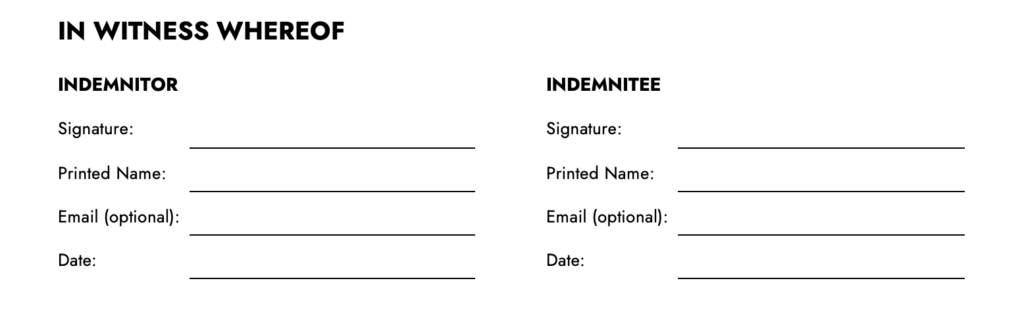
This phrase introduces the signature section and confirms that both parties accept the agreement voluntarily and with full understanding of its terms. Although traditional in language, it serves a formal legal function by marking the point at which the agreement becomes binding. Signature lines follow for each party to enter their name, title if applicable, and the date of signing.
Where Hold Harmless Agreements Are Commonly Used
A Hold Harmless Agreement is often applied in business and service environments where legal risk may arise due to third-party interaction, physical activities, or delegated responsibilities. Common examples include subcontracting relationships, venue or equipment rentals, independent contractor work, and shared-use facilities. A general contractor may use this agreement to limit liability for subcontractor incidents on a job site. An event organizer might include it when coordinating with vendors or hosting in a rented space. This type of agreement helps transfer the risk before problems occur and is commonly used when one party needs to protect itself from claims linked to another’s actions.
Legal Limitations and Enforceability Considerations
Hold Harmless Agreements are not always enforceable in full. Courts may decline to uphold terms that are vague, one-sided, or written in a way that violates state law or public policy. Some jurisdictions limit the use of these agreements in specific contexts such as residential leases or construction projects, while others may enforce them only when both parties clearly understood the risks and responsibilities involved. The agreement must be specific to the activity, relevant to the relationship, and mutually accepted to carry legal weight. Careful wording, transparency, and documented consent all influence enforceability.
About This Template
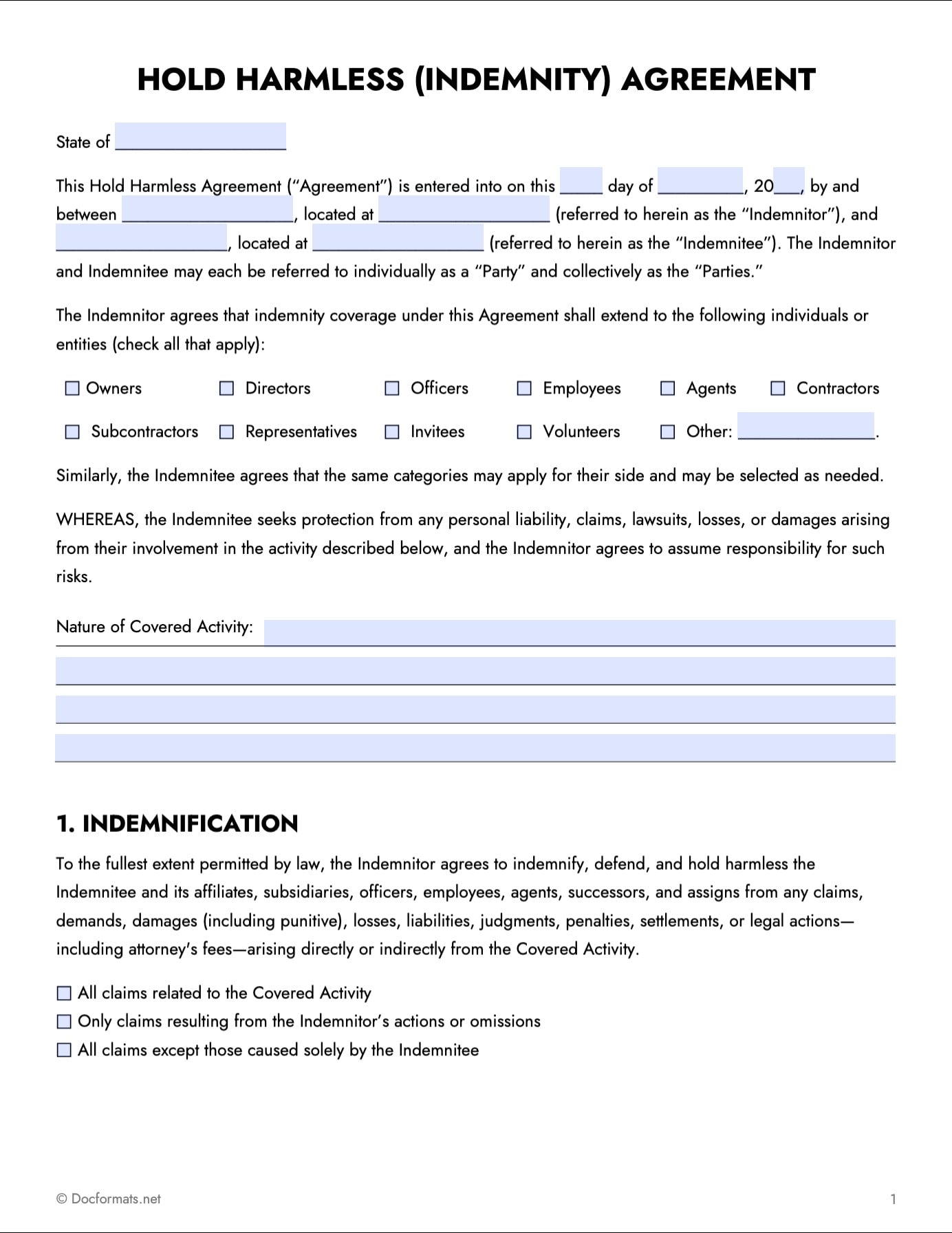
This Hold Harmless Agreement template is available in Microsoft Word, Google Docs, and PDF formats. The Word and Google Docs versions include editable fields and inline guidance notes for each clause. It is recommended to carefully remove the instructional text before finalizing the agreement and to export it as a PDF when sharing by email or printing. The PDF version contains the same content but is designed to be filled directly and does not include instructional notes.